
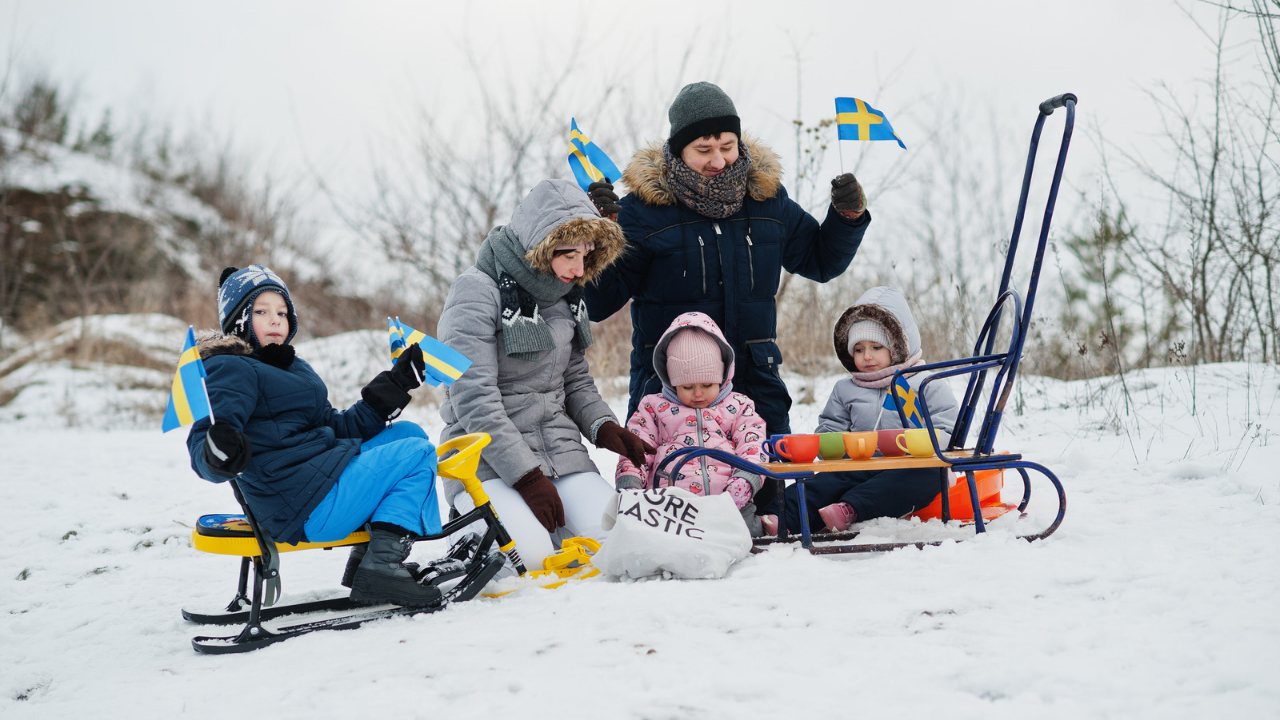
When I wrote about Scandinavian happiness in Part 1, I mentioned hygge. This Danish concept has become almost synonymous with cozy living, good food, friendship, and taking time to enjoy the moment. There is certainly something to it.
I’ve experienced the pleasure of sitting with friends over coffee, enjoying a good meal, talking for hours, and simply allowing the day to unfold without constantly worrying about what needs to happen next. That approach can be wonderful.
However, the more time I spend in Scandinavia, the more I realize that happiness here cannot be explained by candles, coffee, chocolate, and comfortable furniture alone.
Hygge and the corresponding similar traditions in other Nordic countries are part of the picture, but not the whole picture.
Happiness Starts With Security
One of the things that becomes apparent when you spend time in the region is the importance of security. And not the type that first comes to mind, necessarily, if you’re from the US.
In countries such as Denmark, Sweden, Norway, and Finland, people generally have access to broad social programs designed to provide support when life inevitably becomes difficult. Healthcare and education are treated as integral parts of society rather than privileges available only to those who can afford them.
This doesn’t mean that everyone here is wealthy. In fact, becoming extraordinarily wealthy may be harder here than in the United States.
But perhaps that is part of the point.
A society does not necessarily have to have the means to mint new uberwealthy members to make people feel secure.
There is a significant difference between striving to become wealthy and worrying about whether one unexpected event could destroy everything you have worked for.
For many Americans, healthcare is a particularly good example. A serious illness can create enormous financial anxiety. Even people with insurance may worry about deductibles, coverage, medical bills, or what happens if they lose their job.
Living in Scandinavia has made me think about how much mental energy can be consumed by those worries. Financial stress can consume a surprising amount of mental bandwidth.
In a well-known experiment, researchers asked people to think about an unexpected financial problem, such as a car repair. For lower-income participants, contemplating a large expense significantly impaired their performance on tests of fluid intelligence and cognitive control. The difference was roughly equivalent to a 13-point drop in IQ, comparable to the cognitive impairment associated with losing a night of sleep. The researchers argued that when people are preoccupied with how they will meet an urgent financial obligation, fewer cognitive resources remain available for other tasks.¹
When some of those fears are reduced, perhaps there is simply more room for happiness and for people to thrive.

The Scandinavian Approach to Success
The contrast becomes even more interesting when you consider the idea of success.
American culture has always been strongly associated with ambition and individual achievement. The American Dream encourages us to believe that hard work can take us almost anywhere. That idea has inspired generations of Americans.
But there is another way of looking at success. In Scandinavia, there appears to be less emphasis on the idea that everyone must climb as high as possible. There is still ambition, competition, and a desire to succeed, but there also seems to be greater acceptance of a balanced life.
You can have a career without allowing your career to become your entire identity. You can earn a living without believing that your income determines your worth. People have the ability to strive for success while still making time for family, friends, nature, and the simple pleasures of everyday life.
Despite the social programming that puts an inordinate emphasis on productivity, this balance is something I have come to appreciate.
What Happens When Education Is About More Than Tests?
Education provides another interesting window into Scandinavian culture.
The United States has many outstanding teachers and schools, and I would never suggest otherwise. But the American education system has increasingly become associated with standardized testing, performance measurements, competition, and pressure.
When you throw in other obstacles, such as the movement in many US states to ban books, it seems like teaching is growing harder all the time. Teachers often have to accomplish a great deal while working within systems that can be frustrating and restrictive.
Nordic countries, particularly Finland, have taken a different approach.
Finland became famous around the world for its education system, but what interests me most is not simply its academic performance. It is the philosophy behind the system.
Children are not treated as test-taking machines. Education is designed to develop the whole person.
There is room for creativity, play, exploration, cooperation, and time outdoors. The goal is not simply to fill a child’s head with information and then test how much they can remember. It is to help that child learn how to think.
That distinction may be more important than any test score. The benefits of this kind of prioritization and preparation can be seen throughout society.

Trusting the People Who Teach
The Finnish attitude toward teachers is particularly fascinating.
Teaching is considered a respected profession, and teachers are given considerable responsibility for their classrooms. Rather than constantly measuring teachers through standardized tests and rigid accountability systems, there is a greater degree of professional trust.
If you hire and educate professionals, why not trust them?
If you give people responsibility, why not allow them the freedom to exercise it?
The answer is not always simple, of course. Every system needs standards and accountability. But there is something refreshing about beginning with trust rather than suspicion.
Cooperation Over Constant Competition
Another difference I have noticed is the emphasis on cooperation. By contrast, American life can sometimes feel like one long competition.
Children compete for grades. Teenagers compete for college admissions. Adults compete for jobs, promotions, salaries, recognition, and status.
Competition can be healthy. It can encourage people to improve themselves and accomplish great things. But too much competition can also make life exhausting.
The Nordic approach seems to place greater value on cooperation and community. The goal is not necessarily for one person to rise above everyone else. It is often about creating a society where more people can do well.
That is a subtle difference, but it can have a profound effect on how people experience everyday life.
Letting Children Be Children
Perhaps nowhere is this philosophy more visible than in the way children are educated.
I have never been to Finland, but I have spent time in Denmark and Sweden; I’ve noticed how children seem to have opportunities to explore the world around them.
You see them visiting libraries, museums, parks, and other places where they can learn outside the traditional classroom. It’s wonderful watching a child discover something simply because they are curious. That curiosity matters and should be fostered by society by any means possible.
Children should not spend a large portion of their education preparing for the next test, competing with classmates, or worrying about whether they are falling behind.
Children need time to play. They need time to wonder–and time to make mistakes.
Kids need the freedom to be outside and experience the world. Those things are not distractions from education; they are integral parts of education.

Why Are Nordic Countries So Happy?
This brings me back to the question I raised in Part 1.
Why do these societies so often rank highly when people are asked about happiness and quality of life?
The answer probably isn’t one particular tradition or cultural practice. It may be the accumulation of hundreds of smaller decisions about how people should live—and what a society provides for the people who live in it.
Healthcare can ease the fear of what happens when things go wrong. Investment in education can create opportunity, while valuing teachers can give children room to become curious and confident. A culture that places more emphasis on cooperation and less on constant competition can take some of the pressure out of daily life.
And then there are the quieter things: family, friends, nature, good food, conversation, time spent together. The ordinary pleasures that remind us life is supposed to contain more than work.
That brings us back to hygge. Perhaps hygge isn’t the secret to Scandinavian happiness after all. Maybe it’s simply what happiness looks like when people have enough security, time, and balance to enjoy it.
What Living in Scandinavia Has Taught Me About Happiness
I came to Sweden expecting to discover another culture. Instead, I have found myself questioning some of the assumptions I brought with me from my homeland.
I still believe in ambition. I still value hard work. I still admire the US American instinct for independence, risk-taking, and innovation.
But I have also begun to wonder whether we sometimes confuse having more with living better.
Scandinavia has made me think about success in less tangible terms.
How much time do you have for the people you love?
How secure do you feel when something goes wrong?
How much freedom do you have to actually enjoy the life you have built?
Are your children growing up curious and confident?
Do you have enough time to stop and appreciate where you are?
These questions may not appear on an economic report or a school examination. But perhaps they should. Happiness is not something that can be produced by a single government program, education system, or lifestyle trend. It is built slowly, through the conditions of everyday life and the choices a society makes about what matters.
And from what I have experienced in Scandinavia, the foundation may be surprisingly simple:
Give people a sense of security through thoughtful policy decisions. Give children room to grow. Give adults time to live and create a society where success is not measured only by how much one person can gain.
Maybe that is why hygge feels so natural here. When life leaves room for happiness, people have a better chance of finding it.
Footnotes: ¹ Anandi Mani, Sendhil Mullainathan, Eldar Shafir, and Jiaying Zhao, “Poverty Impedes Cognitive Function,” Science 341, no. 6149 (2013): 976–980, https://doi.org/10.1126/science.1238041. The experiment used hypothetical financial scenarios, including a car repair costing either $150 or $1,500. The reported effect among lower-income participants was equivalent to approximately a 13-point IQ difference.



0 Comments